
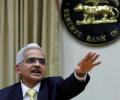
Reserve Bank of India (RBI) Governor Sanjay Malhotra, with Deputy Governors Poonam Gupta, Swaminathan J, T Rabi Sankar, and M Rajeshwar Rao, responded to a range of queries in the post-policy interaction with the media

Equity markets fell on Monday, with benchmark indices recording their worst session in over two months amid caution ahead of the US Federal Reserve's (Fed's) policy announcement and renewed uncertainty over the US-India trade deal. Sustained selling by foreign portfolio investors (FPIs) also weighed on sentiment.

Wholesale price inflation (WPI) fell to (-) 1 .21 per cent in October, driven by a decline in prices of food articles like pulses and vegetables, as well as lower fuel and manufactured items' prices, government data showed on Friday.
Since Sanjay Malhotra took office as governor in December, the Reserve Bank of India (RBI) has adopted a more accommodative stance, which bodes well for banking and the economy as they navigate a growth slowdown, according to analysts.

Monetary policies worldwide has to deal with issues like controlling inflation, promoting growth and financial stability.

'Growth, liquidity and deposit mobilisation are likely to be discussed during the interaction.'

'Credit growth in India remains in double digits, even though corporate borrowing is subdued.' 'Corporate credit is weak because companies are cash-rich and cautious amid global uncertainty.'

The Reserve Bank is unlikely to cut the benchmark interest rate in its forthcoming bi-monthly monetary policy review later in the week as retail inflation is still a cause of concern, and there is a possibility of the Middle East crisis deteriorating further, impacting crude oil and commodity prices, say experts.

State Bank of India, Adani Ports, Tata Consultancy Services, ICICI Bank, Reliance Industries and PowerGrid were also among the laggards.

Reserve Bank Governor Sanjay Malhotra on Wednesday said there is no proposal to levy any charge on UPI transactions.

Shaktikanta Das will demit the office on Tuesday after completing six years as the 25th Governor of the Reserve Bank of India. Revenue Secretary Sanjay Malhotra will replace him as the 26th Governor. He was appointed as the Governor on December 12, 2018, after the abrupt exit of Urjit Patel.

The RBI on Wednesday slashed key interest rate by 25 basis points, for the second time in a row, to support a shuttering economy hit by reciprocal tariffs imposed by the US. Following the rate cut, the key policy rate eased to 6 per cent providing relief to home, auto and corporate loan borrowers.

Among Sensex firms, ITC, Bharti Airtel, Trent, Bajaj Finserv, Titan and Reliance Industries were the major laggards. However, UltraTech Cement, Adani Ports, Tata Motors, Bharat Electronics, Bajaj Finance and Hindustan Unilever were among the major gainers.
The MPC headed by RBI Governor Shaktikanta Das will announce the resolution of the meeting at around noon on Thursday.

Markets ended lower on Monday as investors turned cautious and booked profits ahead of the RBI monetary policy.

The repo rate cut by 25 basis points by the monetary policy committee (MPC) of RBI announced Friday will give a long-awaited relief on interest rates and also be supportive of economic growth, according to experts. Repo rate is the interest rate at which the RBI lends money to commercial banks.
The change in stance to neutral from accommodative in the June monetary policy meeting does not necessarily signal that the Reserve Bank of India's (RBI's) rate setting body - monetary policy committee (MPC) - will go on a prolonged pause on rate cuts going forward, believe experts.
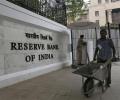
Growth remains weak, inflation is within 2-6% range, rate cut would help recoup forex reserves

'The statistical confidence bands of the fan charts of the forecasts will provide a better sense of the potential variability of outcomes.'

Reserve Bank Governor Shaktikanta Das on Friday said that this stage would have been "premature" and "very very risky" as the retail inflation is still high, and future monetary policy action would depend upon the income data and outlook. Earlier this month, the RBI continued to maintain the status quo in the short-term lending interest rate (repo), citing inflationary concerns, though it changed the monetary policy stance to neutral.

Retail inflation eased to a nearly six-year low of 3.16 per cent in April mainly due to subdued prices of vegetables, fruits, pulses, and other protein-rich items, creating enough room for the Reserve Bank to go for another round of rate cut in the June monetary policy review. The Consumer Price Index (CPI) based inflation was 3.34 per cent in March and 4.83 per cent in April 2024. It was 3.15 per cent in July 2019.

Maruti, IndusInd Bank, Bajaj Finserv, Eternal, Mahindra & Mahindra, Tata Steel, Kotak Mahindra Bank, Titan, HDFC Bank, and NTPC were among the other major gainers. Bharti Airtel and Sun Pharma were the laggards.
The Reserve Bank of India's (RBI's) job to bring down inflation is not over, and any premature move on the policy front could undermine the success achieved so far on the price situation, according to RBI Governor Shaktikanta Das. RBI's rate setting panel, Monetary Policy Committee (MPC), had met for three days from February 6-8. The panel decided to leave the key policy rate unchanged at 6.5 per cent for the sixth time in row.

RBI's interest rate decision, macroeconomic data announcements and global trends are the key factors that would dictate the momentum in the equity market this week, analysts said.
The size of the Reserve Bank's balance sheet as on March 31, 2025 increased by 8.20 per cent year-on-year, leading to a bumper dividend of Rs 2.69 lakh crore for the central government. Increase on assets side was due to rise in gold, domestic investments and foreign investments by 52.09 per cent, 14.32 per cent and 1.70 per cent, respectively, said the RBI's Annual Report for the Year 2024-25 released on Thursday.

Reserve Bank on Wednesday cut India's growth forecast to 6.5 per cent from 6.7 per cent estimated earlier for the current financial year on account of impact of global trade and policy uncertainties. Prospects of agriculture sector remain bright on the back of healthy reservoir levels and robust crop production in 2025-26, RBI Governor Sanjay Malhotra said while unveiling the outcome of the first bi-monthly Monetary Policy Committee meeting for the current financial year.

A day after his appointment as the 26th governor of the Reserve Bank of India (RBI), outgoing Revenue Secretary Sanjay Malhotra on Tuesday said one must understand the economic landscape and do what was best for the economy. "Let me first go, join, understand the turf ... Here it is a different role," Malhotra said, speaking to reporters in front of North Block.

Even as the high inflation figure for October has ruled out any possibility of a rate cut by the Reserve Bank of India's (RBI's) monetary policy committee (MPC) in December, a rate cut in February also looks uncertain due to global uncertainties. Economists told Business Standard that unless domestic growth slows markedly, the outlook on rate cut remains unclear. India's headline inflation touched a 14-month high of 6.2 per cent in October, breaching the MPC's upper tolerance band of 6 per cent.

The Reserve Bank on Friday retained GDP growth forecast of 7 per cent for 2024-25 financial year, lower than the 7.6 per cent expansion estimated for FY24. In its February monetary policy, the RBI had projected the GDP growth rate of 7 per cent for the financial year beginning April 1. Announcing the current fiscal's first bi-monthly monetary policy, RBI Governor Shaktikanta Das said the rural demand is gathering pace, and sustained growth in manufacturing sector should boost private investment.

The rupee continued to face pressure in the first half of the current financial year (FY26), hitting fresh lows against the dollar, due to strengthening of the greenback, rising crude oil prices, and foreign outflows. Rupee has depreciated by 3.7 per cent so far in the current financial year after starting at a good note in April.
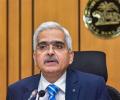
The Reserve Bank of India on Thursday decided to keep policy rate unchanged for the sixth time in a row as it maintains a tight vigil on inflation. The rate increase cycle was paused in April last year after six consecutive rate hikes aggregating to 250 basis points since May 2022.

The Reserve Bank's rate-setting panel began its three-day deliberations on Monday to decide the next monetary policy amid expectations that the central bank will maintain status quo on the benchmark interest rate in the backdrop of global scare due to the new coronavirus variant Omicron. Reserve Bank Governor Shaktikanta Das headed six-member Monetary Policy Committee (MPC) is scheduled to announce the policy resolution on Wednesday. If the RBI maintains status quo in policy rates on Wednesday, it would be the ninth consecutive time since the rate remains unchanged.

The case for a swift and sizable reduction in the repo rate rests on several pillars. First, and most importantly, there is mounting evidence that the five-year old surge in India's economic growth, especially industrial growth, peaked a few months back.

Private sector banks slipped in market capitalisation (mcap) during the July-September quarter, underperforming their government-owned peers as trade uncertainties dragged market sentiment, said S&P Global Market Intelligence. According to its analysis, HDFC Bank shed 4.8 per cent in mcap during the third quarter, while ICICI Bank's dropped 6.7 per cent.

Analysts at Morgan Stanley have updated their outlook for the Indian markets, and they now expect the Sensex to hit the 107,000 mark by December 2026 in a bull-case scenario, translating into an upside of 26 per cent from current levels.

Volatility is likely to continue in the stock market this week amid Omicron uncertainty and the RBI monetary policy meeting will be a key driver for benchmark indices going ahead, say analysts. It will be an event-packed week for the markets, with RBI policy and several macroeconomic numbers scheduled to be announced, they added. "Volatility is likely to continue amid Omicron uncertainty, RBI credit policy, and macroeconomic numbers. "There are lots of news flows on the Omicron variant which are causing volatility in the market while on the domestic front we will have the outcome of an important monetary policy of RBI that is scheduled on December 8. "We will also have our IIP and inflation numbers this week however they will be released on Friday after market hours," said Santosh Meena, Head of Research, Swastika Investmart Ltd.
Wholesale price inflation (WPI) declined to (-) 0.13 per cent in June as prices of food articles and fuel saw deflation, along with easing in manufactured product costs, government data showed on Monday. WPI-based inflation was 0.39 per cent in May. It was 3.43 per cent in June last year.

Widespread use of crypto assets, including stablecoins, can have a negative impact on the macroeconomic and financial stability of a country, the Reserve Bank of India (RBI) said on Monday. In its Financial Stability Report (FSR), the banking regulator highlighted that excessive use of crypto assets can reduce effectiveness of monetary policy, worsen fiscal risks, circumvent capital flow management measures, divert resources available for financing the real economy and threaten global financial stability.

The impact of RBI's monetary policy on the Aam Aadmi of India is going to be minimal.

Reserve Bank Governor Sanjay Malhotra on Friday said the exchange rate policy has remained consistent over the years and the central bank does not target any 'specific level or band' of the rupee, which slipped to an all-time low of 87.59 to a US dollar. On Thursday, the rupee plunged 16 paise to close at a record low of 87.59 against the American currency. "I would like to mention here that the Reserve Bank's exchange rate policy has remained consistent over the years.
